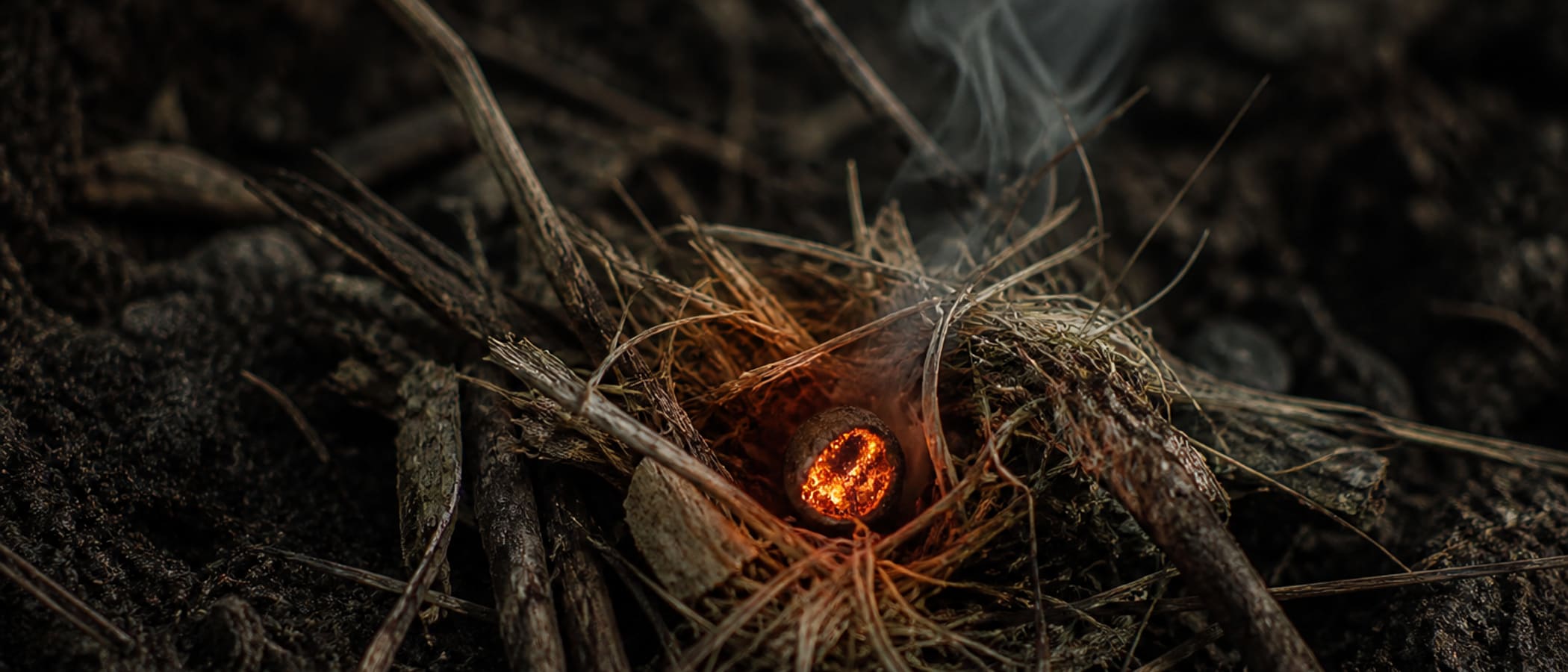
Glowing ember nestled in a dry grass and bark-fiber tinder nest

Skill pillar

Primal Fire

Fire buys you heat, clean water, cooked food, signalling and morale. Under the Rule of Threes it sits with shelter at the top of the urgency stack—especially when wet or cold.

5 Min. Lesezeit5 Methoden

Orientieren
Sicherheitshinweise anzeigen

Szenario

Wet temperate forest, forty minutes of daylight left, no cordage, rain stopped an hour ago.

Bester erster Schritt:

Hunt dry standing deadwood and a protected hearth spot first. A bow drill with the right woods beats a desperate hand-drill thrash on damp wood every time.

Warum es wichtig ist

In the PSR calculator, fire is a core skill pillar. Real-world efficiency is not “can I rub sticks?”—it is choosing a method your materials and biome can actually support before your energy runs out.

Wählen

Tippe eine Methode an, um sie zu lernen – eine nach der anderen.

Nach Region filtern

Tippe ein Biom an, um die Methoden nach Eignung neu zu sortieren. Alle Methoden bleiben für Leser und Suchmaschinen sichtbar.

Vergleich auf einen Blick

Lernen

Diese Methode lernen

Bow drill

A mechanical advantage over the hand drill used across many cultures. The bow multiplies spindle speed so softer wood pairs and tired operators still have a fighting chance.

Auf einen Blick

EnergieaufwandMittlerer EnergieaufwandStill hard work, but the bow trades arm burn for rhythm. Best calorie-to-coal ratio among common friction sets when materials are right.
ZuverlässigkeitHohe Zuverlässigkeit
ZeitSeveral minutes with a proven set; longer while learning

Materialien

  • Bow (springy stick) with cordage (paracord, leather, plant fibre, bootlace)
  • Straight spindle
  • Hearth board
  • Handhold / bearing block (hard wood, bone, or stone with a socket)
  • Coal catcher and tinder nest

Schritte

  1. 1Carve spindle tip round for the hearth and slightly pointed for the handhold; burn in a socket on the hearth.
  2. 2Cut a V-notch to the socket; place a coal catcher underneath.
  3. 3Wrap the bow cord once around the spindle; load spindle into hearth and handhold.
  4. 4Brace the hearth with a foot; bow with smooth full-length strokes while applying steady downward pressure.
  5. 5Increase pace as smoke thickens; when a coal forms, transfer to tinder and blow to flame.

Häufige Fehler

  • Cord slips or saws through—wrong wrap or weak cordage
  • Spindle drills through hearth instead of making powder (too soft hearth or too much pressure early)
  • Handhold smokes or burns your palm—lubricate socket lightly with green leaf or grease
  • Wet tinder kills a good coal—prep the nest before you drill

Eignung je Region

Am besten in: Gemäßigter Wald, Wüste, Gebirge, Küste & Sumpf · Schwach in: Tropischer Dschungel, Schnee & Eis

  • Gemäßigter WaldGut geeignet
  • Tropischer DschungelWenig geeignet
  • WüsteGut geeignet
  • GebirgeGut geeignet
  • Schnee & EisWenig geeignet
  • Küste & SumpfGut geeignet

Legende zur EignungGut geeignetWenig geeignetVermeiden

Clear kit setup and stroke rhythm for a first successful coal.

Weitere Methoden

Hand drill Hoher Energieaufwand · Geringe Zuverlässigkeit

Among the oldest friction methods worldwide—from Aboriginal Australia to the American Southwest—using only spindle and hearth. Minimal kit; maximal technique and fitness.

Materialien

  • Straight dry spindle (softwood or suitable desert plants such as yucca/sotol)
  • Flat dry hearth board of compatible wood
  • Coal catcher (bark, leaf, or dry ground)
  • Fine dry tinder nest (grass, bark fibre, punk wood)

Schritte

  1. Form a shallow depression in the hearth; cut a V-notch to the centre for coal collection.
  2. Kneel or sit so you can spin the spindle between palms with downward pressure.
  3. Spin rapidly from top to bottom of the spindle, resetting hands without losing pressure rhythm.
  4. When dark dust fills the notch and steady smoke rises, stop and nurture the coal into the tinder nest.
  5. Blow steadily into the nest until flame appears; add kindling progressively.

Energieaufwand

Hoher Energieaufwand. Pure muscle and grip endurance. Easy to burn calories and skin before you get a coal if woods or technique are wrong.

Eignung je Region

Am besten in: Wüste · Schwach in: Gemäßigter Wald, Gebirge, Küste & Sumpf · Vermeiden in: Tropischer Dschungel, Schnee & Eis

Häufige Fehler

  • Damp or greasy wood polishes instead of powdering
  • Insufficient downward pressure or uneven spinning
  • Blistered hands mid-attempt—stop and reset kit rather than thrashing
  • Coal dies because the tinder nest is too coarse or wet
Fire plow Hoher Energieaufwand · Mittlere Zuverlässigkeit

A groove-and-plow friction method famously associated with Polynesian and other Pacific traditions—rubbing a softer plow along a harder base until powder ignites.

Materialien

  • Soft dry base board with a straight groove
  • Harder dry plow stick that fits the groove
  • Tinder nest and kindling

Schritte

  1. Cut a shallow longitudinal groove in the base board.
  2. Kneel over the board; drive the plow back and forth with long, firm strokes.
  3. Push powdered dust to the end of the groove where it can collect and heat.
  4. When the dust pile smokes and glows, tip or transfer into tinder and blow to flame.

Energieaufwand

Hoher Energieaufwand. Whole-body effort with less mechanical advantage than a bow. Rewarding when bamboo or soft tropical woods are available; punishing when wood is wrong.

Eignung je Region

Am besten in: Tropischer Dschungel, Küste & Sumpf · Schwach in: Gemäßigter Wald, Wüste, Gebirge · Vermeiden in: Schnee & Eis

Häufige Fehler

  • Groove glazes and stops producing dark powder
  • Plow and base too similar in hardness
  • Dust scatters instead of piling at the hot end
  • Exhaustion before ignition—rest and reseat posture
Fire saw / bamboo fire saw Mittlerer Energieaufwand · Mittlere Zuverlässigkeit

Southeast Asian and Pacific technique using a bamboo or softwood “saw” across a notched piece—excellent where bamboo is abundant and dry enough.

Materialien

  • Section of dry bamboo or suitable softwood
  • Cutting edge piece (bamboo strip or hardwood saw)
  • Tinder packed into or beneath the notch

Schritte

  1. Split and prepare a hearth piece with a notch or split that will catch hot dust.
  2. Pack fine tinder into the catch area.
  3. Saw vigorously across the hearth with firm downward pressure.
  4. When dust ignites or a coal forms in the tinder, blow carefully to flame.

Energieaufwand

Mittlerer Energieaufwand. Short, intense bursts. Efficient in bamboo country; nearly useless without the right plant materials.

Eignung je Region

Am besten in: Tropischer Dschungel · Schwach in: Gemäßigter Wald, Küste & Sumpf · Vermeiden in: Wüste, Gebirge, Schnee & Eis

Häufige Fehler

  • Green bamboo sweats moisture into the dust
  • Notch geometry fails to trap powder
  • Saw edge rounds off—reshape and continue
  • Trying this outside bamboo/softwood regions wastes critical energy
Percussion (flint and steel / rock strike) Geringer Energieaufwand · Hohe Zuverlässigkeit

Striking high-carbon steel on flint (or suitable rock pairs) to throw sparks into char cloth or natural tinder fungus. Historic across Eurasia; “primitive-adjacent” when steel is available from kit or scavenged metal.

Materialien

  • Hard sharp rock (flint, chert, quartzite) or ferrocerium if modern
  • High-carbon steel striker or equivalent
  • Char cloth, amadou, or prepared fine tinder
  • Kindling ladder

Schritte

  1. Prepare a dry tinder bed that catches sparks easily.
  2. Strike glancing blows so sparks shower into the tinder.
  3. When a spark catches, gently blow to a glowing coal then flame.
  4. Build the fire with pencil-lead twigs upward to finger-thick fuel.

Energieaufwand

Geringer Energieaufwand. Low calorie cost if you have the materials. The scarce resource is prepared tinder and a reliable spark pair—not muscle.

Eignung je Region

Am besten in: Gemäßigter Wald, Wüste, Gebirge, Schnee & Eis, Küste & Sumpf · Schwach in: Tropischer Dschungel

Häufige Fehler

  • No charred or ultra-fine tinder—sparks die instantly
  • Wrong rock that powderizes instead of sparking
  • Wet hands or damp char cloth
  • Wasting steel/rock energy before tinder is ready
Bewerten

Kompetenzstufen

Ehrliche Selbsteinschätzung mit denselben Stufen wie im Rechner.

  1. Keine

    Cannot produce flame from primitive means; depends entirely on modern lighters or others.

  2. Grundlegend

    Can maintain and rebuild a fire from existing coals; may get a coal with a proven bow-drill set in dry conditions.

  3. Geübt

    Can select woods, build a set from scratch, and get flame in damp-but-not-soaked temperate conditions.

  4. Experte

    Multiple methods across biomes; improvises cordage and tinder; teaches others and still respects fire bans and weather.

Häufige Fragen

What is the most efficient primitive fire method?

For most temperate and dry biomes, a well-made bow drill offers the best balance of reliability and energy cost. Hand drill is kit-light but calorie-heavy. Bamboo fire saw wins only where bamboo is dry and abundant. Percussion wins if you have steel and charred tinder.

Why does fire fail in jungle or arctic attempts?

Moisture and cold kill powder quality and tinder. In jungle, prioritize dry standing bamboo or protected deadwood and consider plow/saw methods. In arctic conditions, friction wood is scarce and wet—focus on fat-rich fuels and spark methods if any metal/rock pair exists, and never waste calories on doomed friction attempts.

How should I rate my fire skill in the PSR calculator?

Match the skill ladder on this page: None if you only use modern igniters; Basic if you can keep a fire alive; Proficient if you can create flame from a scratch friction set in fair weather; Expert if you can do so across biomes and materials.

Bewerte dich

Mach die PSR-Bewertung und beurteile diese Fähigkeit ehrlich.

Die Artikel des Guides sind in dieser Version auf Englisch geschrieben. Die Bedienoberfläche folgt deiner Sprachauswahl.