
Navigation & Signalling
Sun & star orientation
Pre-compass cultures used solar arcs and star paths; still useful when electronics fail.
At a glance
Energy investmentLow energyObservation only—until you start marching.
ReliabilityMedium reliability
Time15–30 minutes for a bearing sense
Materials
- Clear sky
- Stick shadow method
- Northern/Southern hemisphere star knowledge
Steps
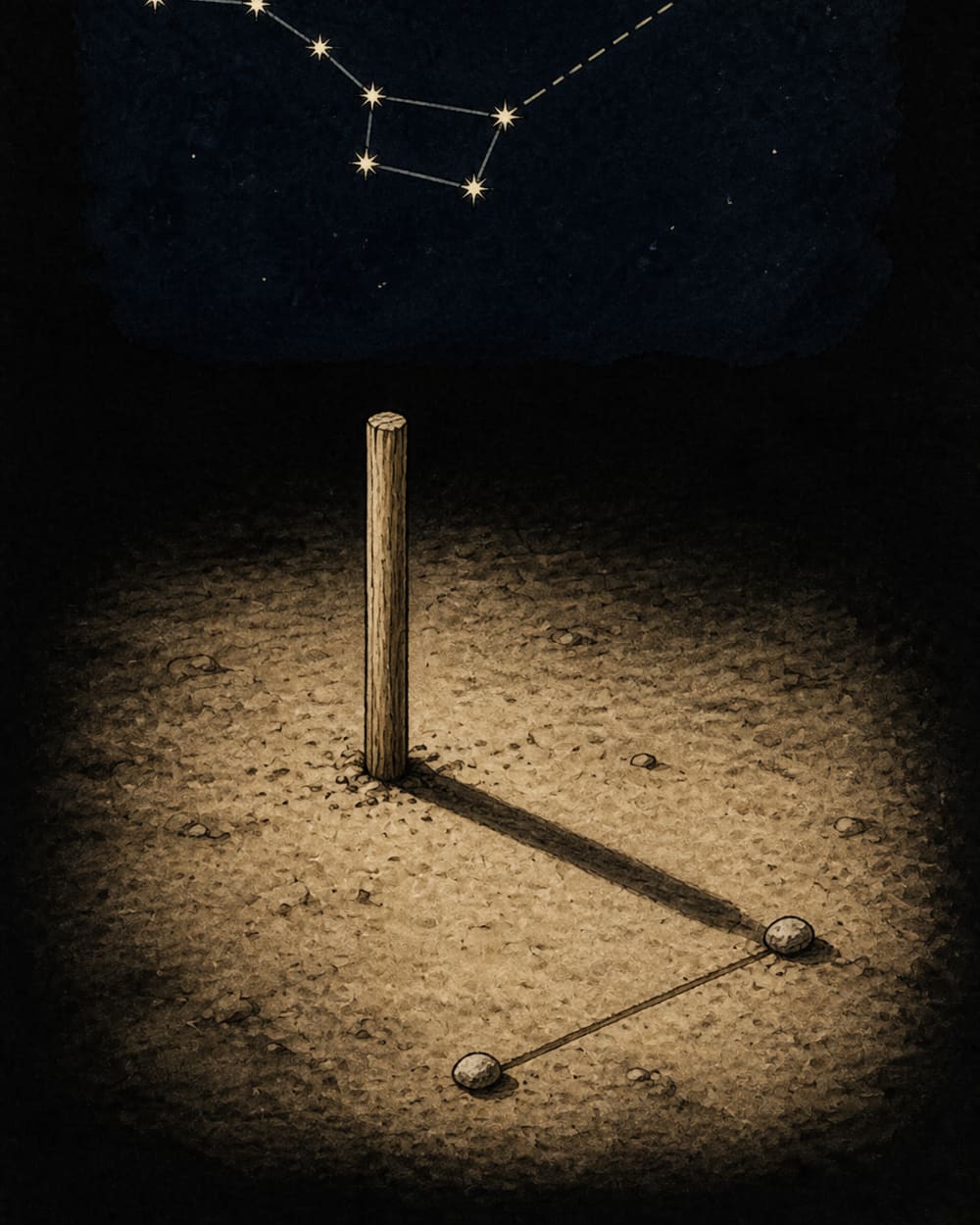
- 1Shadow-stick: mark the shadow tip (west), wait 15+ minutes and mark the new tip (east). Stand with the first mark on your left and you face roughly north.
- 2At night in the Northern Hemisphere, follow the two pointer stars of the Big Dipper to Polaris, within about a degree of true north. In the Southern Hemisphere, extend the long axis of the Southern Cross about four and a half lengths to find the south celestial pole.
- 3If you later switch to a compass, correct for magnetic declination—the local angle between magnetic and true north, which drifts over time (NOAA publishes a free calculator).
- 4Confirm with terrain—never trust a single cue.
- Overcast sky
- Magnetic anomalies near metal (if using compass later)
- Confusing hemisphere star rules
Region fit
Best in: Desert, Mountains, Coast & swamp · Poor in: Temperate forest, Tropical jungle, Snow & ice
Temperate forestPoor fit Tropical junglePoor fit DesertGood fit MountainsGood fit Snow & icePoor fit Coast & swampGood fit
Fit keyGood fitPoor fitAvoid
Other methods
Rate yourself
Take the PSR assessment and score this skill honestly.